

I have received an enthusiastic response to my article written late last week, about why the social “we”b is about the real-world relationships, just as much as it is about online interaction. In that, I recollected how the best side-effect of Twitter has been the number of highly talented individuals I’ve been able to meet around the world.
I’ve got a bunch of emails, tweets and comments over the last couple of days asking me how this observation applies to airlines. Firstly, let me address why airlines need to have real-world interaction with their online “fans”.

Why is real-world interaction needed to complement social media engagement?
Online interaction is good, because it allows the airline to connect with a lot of people across geographies, and allows those people to connect among themselves too.
Where online engagement falls short is often the creation of a long-lasting emotional bond, which comes only through real-life meetings. Imagine a Facebook fan of an airline, who has never flown them before, but has always taken part in online contests or discussions. Wouldn’t the relationship be cemented only if he flies that airline at least once? Or if he gets to meet in person with some of the people behind the airline? Or be invited to an event organized by the airline? The chances of turning a loyal online fan into a loyal customer increase dramatically when real-world interaction complements online engagement.
So, how can airlines foster real-world interaction?
Here are 10 simple-to-execute ideas, that work
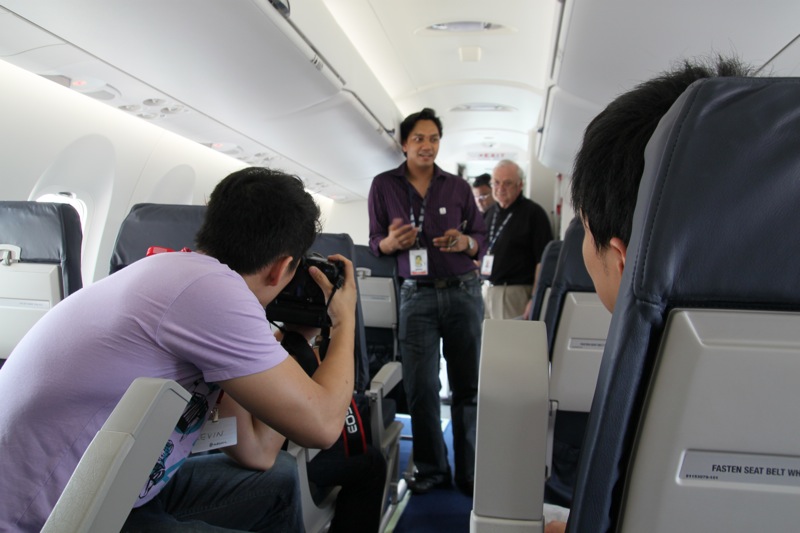
- Organize a Tweet-up – It’s as simple as sending out a Tweet, or going to http://twitvite.com/ to create an event for your followers. If your airline doesn’t have a Twitter account, then create a Facebook event and invite your fans to hang out together. The value you’re offering is to connect them with one another in the real-world. The benefits of such events can be far beyond expected, as we experienced with the Bombardier Tweetup on-board a Q400 at the Singapore Airshow 2010.
- Translate ideas sought online into real-world action – Full fledged ideation communities are popular with brands. Starbucks is famous for My Starbucks idea, Dell has Dell Ideastorm. Airlines need not do something as extensive – but anything that gives their customers and online fans a sense of ownership of the brand can do wonders. AirTran very successfully introduced wifi on all its flights after running a competition on Everyflight.com. More recently, airBaltic [Disclosure: SimpliFlying client] painted the flags of the EU nations on its planes after seeking suggestions on its Facebook page.

- Invite your online fans to your facilities – AirAsia ran a competition on their blog last year, where the winners would get to come down to their training center in Kuala Lumpur. The event generated a lot of excitement among the fans, who got to check out what goes on behind the scenes – certainly fostering stronger bonds with the brands.
- Have a gathering in each of your major cities – Alaska Airlines is very good at organizing such meetups, especially with their loyal fans and frequent fliers. I’ve been to one of them myself, in Seattle, and it was a revelation. These meetings really help!
- Get senior executives to have candid conversations with fans, online and offline – Malaysia Airlines did a fascinating job when it got its CEO, Idris Jala, to meet with some of the selected Facebook fans from the airline’s Fanpage. And the event ended with Mr Jala playing a song on the guitar, himself. That connection was hard to achieve otherwise, and made the “CEO of an airline”, very human. It helps bridge the gap.
- Complement new route-openings with online events tied with offline ones – Southwest Airlines opened up a cafe in New York’s Bryant Park, to commemorate opening its flights to LaGuardia! And for the launch, they invited again – their Facebook fans and Twitter followers. I was there as well, and it was the first time I interacted with so many Southwest “fans”. Feels good to be part of the family
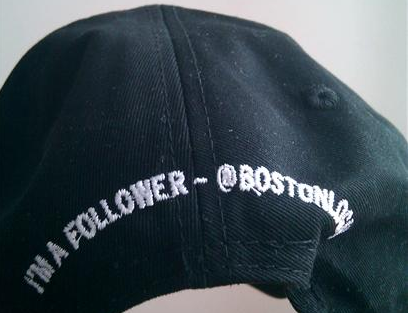
- Recognize your most loyal online fans – Just like FourSquare Mayors get free coffee at certain cafes. Boston Logan Airport sent me a black hat with the words “I’m a followers of @bostonlogan”. And what did I do? And I told everyone about it on Twitter and even posted up a photo. “Real love” always helps spread the brand further.
- Drive awareness about your online efforts, in-flight – I’ve always believed that airlines have that unique advantage that few other brands have – they hold their customer captive for long periods of time. Brand engagement in an airline’s case is much longer – in-flight, and this can be leveraged upon, for interacting with the customers at a new level. How about giving your Facebook fans free on-board wifi-access? Or giving your Twitter followers priority boarding on their birthdays? Little gestures can go far. Very far.

So, what do you think? How crucial is real-world interaction in making airlines’ social media strategy a success? Do you have examples to share? Let’s here it in the comments and on Twitter (@simpliflying)


![Reblog this post [with Zemanta]](http://img.zemanta.com/reblog_c.png?x-id=6434cbb7-0424-4473-b296-8449131fe56c)


Great post – especially like #3 and #8.
The airline industry, to the average traveler, must seem somewhat massive, cold and almost intimidating in terms of the size/scale of service it provides and the level of security around it, yet those traits also are what make it so mysterious and interesting. Connecting average end-travelers to your brand by bringing them to where the action happens (facilities) is a fantastic idea for airlines to increase loyalty and brand affinity… and even as an ancillary benefit, perceived level of safety.
Who might you trust with your family and/or perceive to be safer? The airline you know little to nothing about, or the one who opened its doors and showed you exactly what makes it such a great airline… again, great idea.
And on #8, I totally agree with regard to unique advantage in holding customer captive – so much opportunity in this area, of which I believe maybe 5% has been take advantage of to-date. Even beyond even what you are suggesting, much unchartered territory. But we both know small steps for airlines is is better than no step at all, and free WiFi for Facebook fans or birthday priority is a great start… for WiFi, though, I think there might have to be more to that puzzle to make it work from a margin perspective (some take a cut per passenger connection, others have incredibly high up-front hardware costs i.e. 200K/plane), but my guess is they haven't even explored the idea far enough to know one way or another.
Hopefully ideas like these will catch on and at least begin to be tested to see what sticks… mainly for selfish reasons, because I want one of the behind-the-scenes facilities tours asap.
April 13th, 2010 at 3:10 amSarah, thanks for such an encouraging response! Glad you liked the
April 13th, 2010 at 3:40 amideas. As you can see, a lot of airlines have adopted them already,
and I'm sure a lot more will adopt them. The biggest question is –
when! And who will make these a competitive advantage. Any guesses?
Aviation has always been about people, those who fly and those who make flights happen. It has never been about aircraft and services, it is the people behind these things that matter. Airline executives and airlines sometimes tend to forget that flying is really about people, real live people and not numbers.
This is why social media can be crucial to an airline brand. It is about people. I agree that #8 is probably the biggest lost opportunity for an airline to interact with their passengers who invariably are their loyal fans. New aircraft has made long range travel so viable, almost all the flights I take are between 8 and 15 hours long. The sad thing is airlines try to keep passengers busy with IFE or asleep instead of interacting and bonding.
April 14th, 2010 at 12:32 pmYou know Oussama, in your comment, I like the first sentence the best.
April 14th, 2010 at 3:11 pmAirlines are indeed the people business, not the transport business –
as is the dominant perception. Airlines that get this do well –
Southwest, JetBlue, Volaris, Singapore Airlines and more!
A fantastic article and I agree with every word. As an avid “Tweeter” I can tell you I've tweeted both Southwest & AirTran a number of times over months without so much as a “Hi! How YOU doing?” in return. It always makes me wonder whether they really understand that their social media presence is about a “conversation” rather than a constant stream of announcements or RT's that relate specifically to their brand. I'd love to see them put more of a personal spin to their Twitter accounts, if for no other reason than to establish themselves as something other than a nameless, faceless business when (not if) trouble arises and they need to respond to their followers about it.
If I like you, and have developed a positive online “relationship” with you, I'm far more likely to hear what you have to say about any problems that come up and receive it with welcoming ears.
Thanks again for the great article.
April 14th, 2010 at 3:32 pmBang on target with your thoughts, Sher!
April 14th, 2010 at 3:47 pmShashank, I really liked the points that you have enumerated in the article. Real life interaction after getting in touch with the customers through social media is very helpful to achieve the desired end. But, in my opinion, many airlines falter in the initial stage of defining the goal for its marketing team. The potential of social media in reaching out to the customer is immense. At the same time, it needs to be handled deftly, for, it’s a powerful tool.
April 23rd, 2010 at 6:50 amI couldn’t agree more with the view about aviation being people business. And, social media offers you to know about these people so well. Take a peep at the database of FFP and there you are…..you know him well enough to customize his travel experience or in other words to delight him while he goes from A to B!! Most of the airlines which have leveraged the use of social media have clearly articulated the initiative to its team. They reach out to customers, they discreetly screen the category of customers which require more attention/bytes, have a focused brand message and a have a genuine concern for its customer. Such an approach will alleviate the deficiency in social media initiative that Sher mentioned. The need in his case was, “hey…so nice to have you here in the virtual space and appreciate that you have taken time out for us!”. The airline industry has another distinct advantage: one does not have to generate interest in this industry. There is so much curiosity in young and old alike about the science of flying. In my interactions during flight, I am surprised by the interest that people show. Just by sharing the knowledge, ‘customers’ are happy to have interacted with an aviation guy and learn something new(could be a trivia about how the new generation planes have evolved!). Once again, appreciate your comments.
All birthday very good start for a birthday invitation. Birthday invitation does not mean only the recipient the essential information about what, where and when he creates the mood and spirit of the event. Create anticipation! If things went right, everyone gets a birthday invitation to get in the right place at the right time, and protective clothing in a spirit of connection. This article is a useful guide for all those who send birthday invitations. The great website you should visit http://www.firstbirthdayinvitations.biz
August 28th, 2010 at 5:56 pm