REPORT
What could strengthen
aviation’s decarbonisation efforts?
What could strengthen
aviation’s decarbonisation efforts?
Our report highlights five second-generation technologies to watch in 2026 that could unlock aviation decarbonisation by removing key bottlenecks across SAF, synthetic fuels, electrification, and carbon removal.
What is actually holding aviation decarbonisation back?
The broad shape of net-zero aviation is not a mystery. The destination, and the ways of getting there, are understood.
Medium- and long-haul flight will rely on drop-in fuels compatible with today’s aircraft. These will come from a variety of feedstocks, including as we get into the next decade, non-fossil carbon and hydrogen.
Shorter routes will use electric, hybrid electric or hydrogen where physics allows. Airports will electrify ground operations, tackle non-CO₂ effects such as contrails, and draw more heavily on clean power.
Residual emissions will require permanent carbon removal, where CO₂ is captured and stored deep underground.
So we know what to do. Most of the technology to do it exists. The issue, though, is that every one of these pathways runs into a hard constrain.
This report focuses on five areas where second-generation approaches are emerging to address specific bottlenecks: natural hydrogen, on-site battery storage and microgrids, new nuclear, Direct Air Capture, waste-to-SAF.
Five promising technologies to watch in 2026
Natural hydrogen
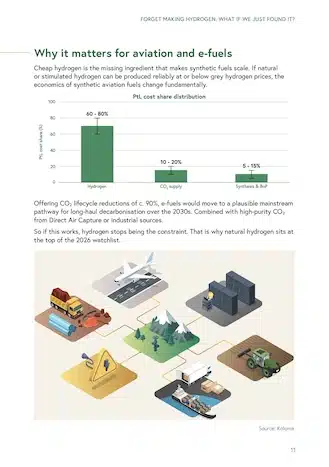
This could radically lower the cost of synthetic fuels if recoverable at scale.
On-site battery storage and microgrids
Particularly significant as airports confront rising electricity demand and grid fragility.
New nuclear
This would include small modular and micro-reactors, as a source of constant, low-carbon power.
Direct Air Capture 2.0
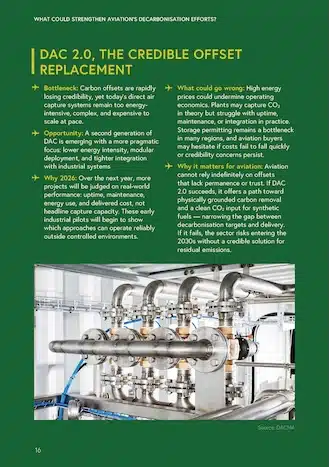
As the sector shifts toward more energy-efficient systems, DAC shows great promise for aviation decarbonisation.
Waste-to-SAF 2.0
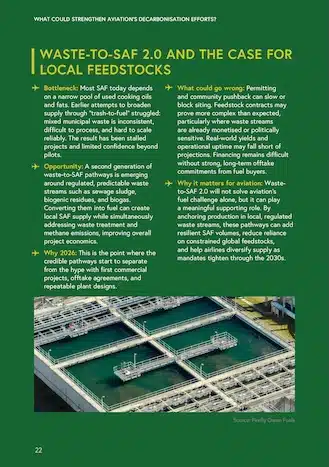
This pathway uses regulated biogenic waste streams rather than mixed municipal waste.