REPORT
Alcohol-to-Jet as the bridge to
scalable Sustainable Aviation Fuel
Alcohol-to-Jet as the bridge to
scalable Sustainable Aviation Fuel
This paper examines Alcohol-to-Jet as the critical near-term SAF pathway, bridging constrained HEFA supply and future Power-to-Liquid fuels by leveraging mature technology, abundant feedstocks, and strong decarbonisation potential to enable aviation’s transition to net zero.
AtJ as aviation’s essential bridge
Aviation faces a critical, dual challenge: supporting growth that is projected to more than double by 2050, while simultaneously achieving net-zero emissions within the same timeframe.
Sustainable Aviation Fuel (SAF) is currently the only commercially available solution capable of delivering the required decarbonisation for the existing fleet, accounting for an estimated 65% of the sector’s climate mitigation goal.
The dominant SAF production pathway, Hydroprocessed Esters and Fatty Acids (HEFA), is rapidly approaching feedstock limits, as is evidenced by the rising prices and the United States becoming a net importer of waste oils.
Power-to-Liquid (PtL) fuels, in contrast, offer long-term scalability but remain years away from commercial viability due to high capital costs and expensive production.
Alcohol-to-Jet (AtJ) technology has emerged as the essential bridge between today’s limited HEFA production and the next decade’s volumetric needs. AtJ converts abundantly available renewable alcohols into jet fuel using established chemical processes.
Key takeaways
The AtJ advantage
The AtJ pathway offers distinct strategic advantages grounded in its ability to integrate with existing industrial infrastructure. This integration creates resilient, distributed supply chains capable of scaling rapidly without the prohibitive capital demands of greenfield construction.
Commercial momentum
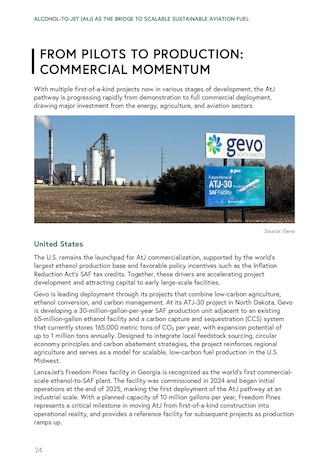
With multiple first-of-a-kind projects now in various stages of development, the AtJ pathway is progressing rapidly from demonstration to full commercial deployment, drawing major investment from the energy, agriculture, and aviation sectors.
Feedstock availability is AtJ’s decisive advantage
AtJ can draw on vast global ethanol supplies from corn, sugarcane and agricultural residues, offering more scalable feedstock than HEFA without triggering food or land-use displacement.
Emissions reductions
AtJ fuels – particularly those using cellulosic or waste-derived ethanol in net-zero plant designs – can reach 70–90% reductions or better, positioning the pathway among the highest-performing near-term options.