REPORT
Pathways to Sustainable Aviation Fuel
A SAF Strategy Playbook For European Airlines
Pathways to Sustainable Aviation FuelA SAF Strategy Playbook For European Airlines
Our report serves as a decision-support tool for airline teams managing SAF cost exposure, compliance risk, and procurement strategy, focusing on the second half of this decade to 2030.
Introduction
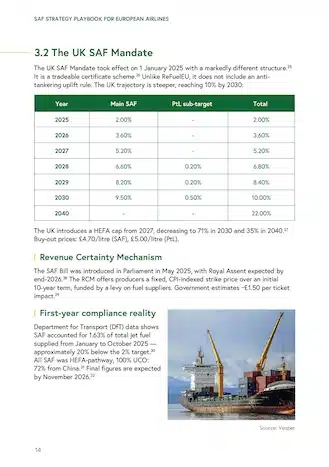
European airlines now operate under two binding SAF mandates — ReFuelEU Aviation in the EU and the SAF Mandate in the UK — with different structures, different targets and different enforcement mechanisms. Any carrier with operations in both jurisdictions needs a compliance strategy for each.
While no one knows exactly how SAF markets will develop between now and 2035, airlines cannot wait for certainty before acting. Decisions made in 2026 will determine cost exposure and supply access for the rest of the decade.
This report is a decision-support tool for airline teams navigating sustainable aviation fuel (SAF) cost exposure, compliance risk and procurement strategy with a primary focus on the second half of this decade to 2030.
This analysis has been commissioned as part of SimpliFlying’s role as research partner to the Sustainable Aviation Futures Congress, whose European edition will take place in Amsterdam from 15 to 17 June 2026.
IN PARTNERSHIP WITH

Ten essential SAF questions for airline leadership teams
How much SAF cost exposure are you budgeting for 2025–2030
With EU mandates rising from 2% in 2025 to 6% by 2030 and the UK reaching 10% by 2030, SAF costs for airlines are bound to increase.
Are your fuel suppliers’ compliances fees fair?
Fuel suppliers could be charging airlines above implied market-based costs, making it essential to benchmark fees against published SAF price indices.
What is your eSAF exposure, and do you understand the penalty risk?
The EU’s synthetic fuel sub-mandate requires 1.2% eSAF by 2030, but there are barely any large-scale commercial eSAF production facilities in Europe.
Do you have a dual-mandate compliance strategy for both the EU and UK?
EU and UK SAF mandates differ in design, targets, and enforcement, requiring airlines operating in both jurisdictions to manage separate compliance strategies.
Are you planning for SAF cost pass-through to passengers?
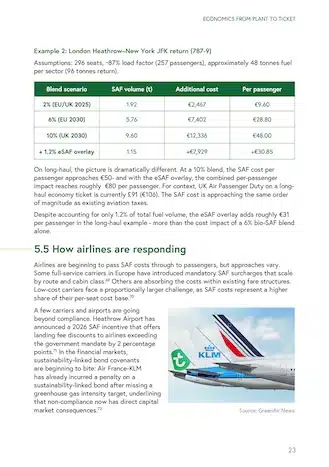
The UK estimates SAF will add ~£1.50 per ticket, but long-haul costs could reach €48 or more at a 10% SAF blend, and could rise further with eSAF use.
How exposed are you to feedstock concentration risk?
In 2024, SAF production relied heavily on used cooking oil, largely imported and often sourced from China.
What is your offtake strategy and does it match the mandate ramp-up?
SAF producers need 5-10+ year offtake agreements to secure financing, but airlines’ reluctance to commit beyond 3–5 years is slowing down new supply.
Are you engaging with the EU’s Strategy for Transition and Industrial Partnerships (STIP) and eSAF Early Movers Coalition?
The EU STIP for aviation e-fuels targets €2.9 billion in mobilised investment by end 2027. The associated eSAF Early Movers Coalition includes a pilot double-sided auction worth €500 million.
How does your SAF strategy interact with the EU ETS and UK ETS?
With free EU ETS aviation allowances ending in 2026, SAF use is supported via FEETS, providing roughly €1.5 billion through 2030.
Can you credibly deliver your public 2030 SAF commitment?
With global SAF production forecast at roughly 0.8% of jet fuel consumption in 2026, the gap between corporate pledges, mandates and available supply is wide.