REPORT
Sustainable Aviation
Outlook 2026
Sustainable Aviation
Outlook 2026
Based on responses from 26 airlines, our third annual report explores how airlines are addressing the challenges of SAF procurement under evolving regulations, and preparing for CORSIA compliance.
The state of sustainable aviation
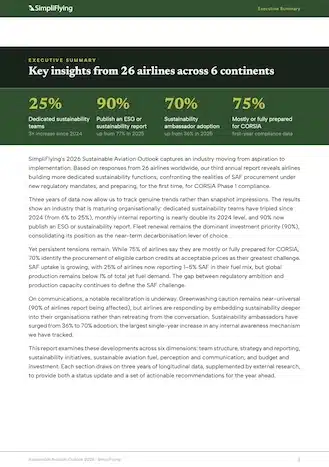
Our 2026 Sustainable Aviation Outlook captures an industry moving from aspiration to implementation. Based on responses from 26 airlines worldwide, our third annual report reveals airlines building more dedicated sustainability functions, confronting the realities of SAF procurement under new regulatory mandates, and preparing, for the first time, for CORSIA Phase 1 compliance.
Three years of data now allow us to track genuine trends rather than snapshot impressions. The results show an industry that is maturing organisationally: dedicated sustainability teams have tripled since 2024 (from 6% to 25%), monthly internal reporting is nearly double its 2024 level, and 90% now publish an ESG or sustainability report. Fleet renewal remains the dominant investment priority (90%), consolidating its position as the near-term decarbonisation lever of choice.
Yet persistent tensions remain. While 75% of airlines say they are mostly or fully prepared for CORSIA, 70% identify the procurement of eligible carbon credits at acceptable prices as their greatest challenge. SAF uptake is growing, with 25% of airlines now reporting 1–5% SAF in their fuel mix, but global production remains below 1% of total jet fuel demand.
On communications, a notable recalibration is underway. Greenwashing caution remains near-universal (90% of airlines report being affected), but airlines are responding by embedding sustainability deeper into their organisations rather than retreating from the conversation.
This report examines these developments across six dimensions: team structure, strategy and reporting, sustainability initiatives, sustainable aviation fuel, perception and communication, and budget and investment. Each section draws on three years of longitudinal data, supplemented by external research, to provide both a status update and a set of actionable recommendations for the year ahead.
6 dimensions of sustainability covered in the report
Team structure
The shift from ad-hoc responsibility to dedicated resourcing is accelerating, with larger teams, more specialised structures, and stable executive leadership emerging as consistent themes.
Sustainability strategy and reporting
This year’s survey reveals continued progress in reporting frequency and ESG disclosure, alongside a sobering picture of net-zero target verification and Scope 3 ambition. For the first time, the survey also captures data on CORSIA compliance preparedness, providing an early benchmark for an industry entering the final year of CORSIA’s first phase.
Sustainability initiatives
Airlines are doubling down on proven efficiency measures, particularly recycling and waste management, while sharply pulling back from next-generation fleet technology investments. Carbon neutralisation strategies are also evolving, with a growing proportion of airlines pursuing combined offsetting and direct carbon removal approaches.
Sustainable aviation fuel
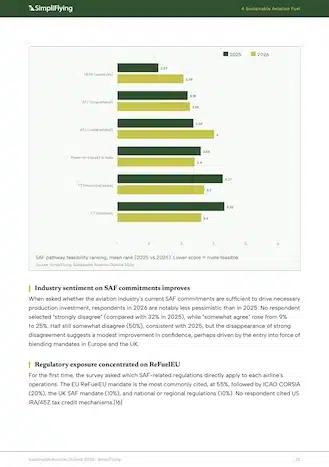
This year’s survey, now in its second year as a standalone SAF section, reveals growing airline engagement with SAF procurement, a rebalancing of views on fuel pathways, and, for the first time, data on regulatory exposure and compliance strategies.
Perception and communication
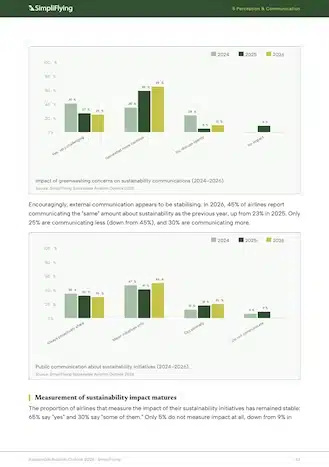
Airlines are stabilising their external messaging, investing heavily in internal sustainability structures, and navigating a regulatory environment that is becoming progressively less tolerant of unsubstantiated environmental claims. The data suggests an industry that is learning to talk about sustainability with greater precision, even as it remains cautious about how much to say.
Budget and investment
The share of airlines with both sustainability KPIs and incentive structures has doubled. Fleet renewal has consolidated its position as the dominant near-term investment, while technological and cost barriers show nuanced movement. Budget disclosure, by contrast, has declined sharply.